
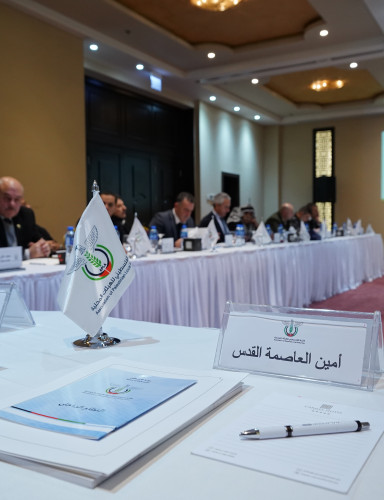

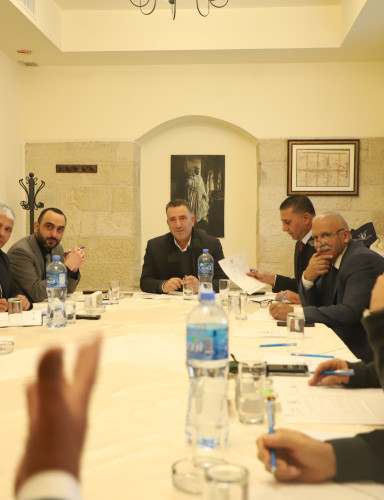




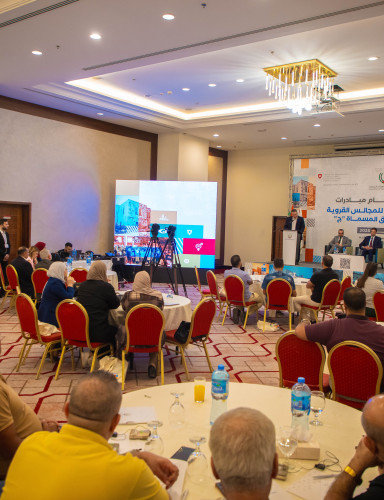



The Association of Palestinian Local Authorities (APLA) launched a focused training program for the field and office teams working on the Historic Buildings Documentation project, implemented in partnership with UNESCO and in cooperation with the Ministry of Tourism and Antiquities (MoTA). The project also engaged coordinators from the municipalities of Hebron, Beit Kahil, Taffuh, and Halhul.
The training brought together 35 representatives from the technical and administrative staff of all four municipalities, along with representatives from APLA, MoTA, UNESCO, and the field research team. The event was part of the project’s first phase, which sought to survey and catalogue tangible cultural heritage in these sites in preparation for establishing a comprehensive national database of historic buildings to be registered with the relevant official authorities.
The training included a detailed presentation on methodologies for collecting field data, both on paper and electronically, as well as instruction on the use of cultural property survey forms and standards for architectural and historical documentation. During the training, employment contracts were also signed with 22 field researchers, who were recruited to work on the project.
Dr. Ahmed Jaber, APLA Sustainable Development Project Officer, asserted that the “project is the first of its kind nationwide and reflects APLA’s commitment, in partnership with UNESCO and in cooperation with MoTA, to supporting local authorities in preserving cultural heritage. It provides the necessary technical and logistical support to ensure the highest quality standards of implementation.”
Mr. Jabr Rjoub, Director of the Hebron MoTA Directorate, stressed “the importance of this national project, which contributes to the preservation of Palestinian heritage and history and reflects the Ministry’s vision for documenting historic buildings in the governorate. The current phase covers Hebron, Beit Kahil, Taffuh, and Halhul, with plans for subsequent expansion to other parts of the governorate.”
Eng. Murad al-Tamimi, the project representative from Hebron Municipality, explained the data collection process, which used the paper survey form and its conversion into digital format through a dedicated application. Al-Tamimi noted that the form captures detailed information about the property’s nature, construction methods, uses, and historical and cultural significance.
Eng. Amir Abu Eisheh, the project coordinator from the UNESCO Ramallah Office, highlighted the importance of linking geographic data with spatial information to create accurate maps of historic buildings and facilitate their use for preservation and documentation purposes.
This project is part of APLA’s efforts to safeguard cultural heritage and strengthen the capacities of local government units (LGUs). Funded by the UNESCO Heritage Emergency Fund and implemented through close collaboration between the UNESCO Ramallah Office and MoTA, it aims at supporting the documentation of historic buildings according to unified methodologies and contributing to the establishment of a national database of immovable heritage to preserve Palestine’s cultural heritage.


