
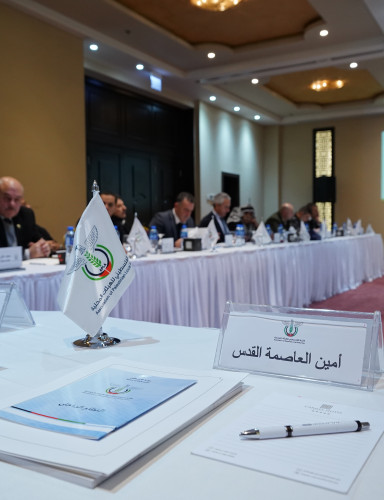
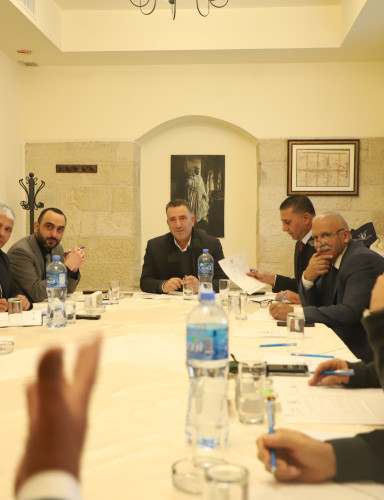


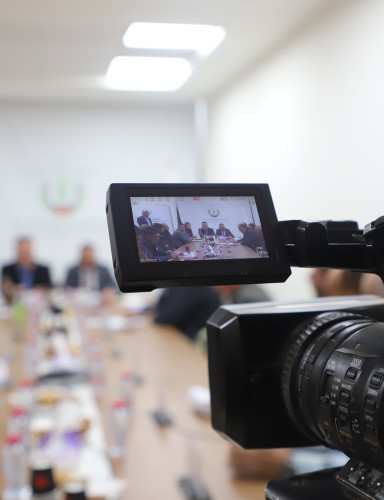
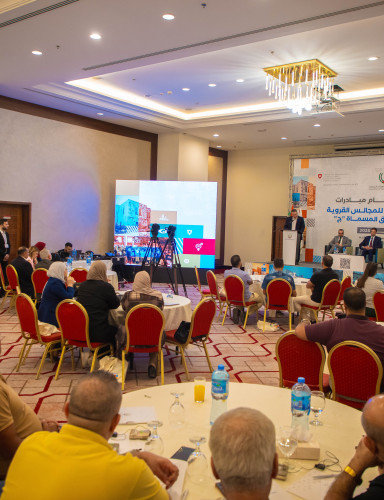
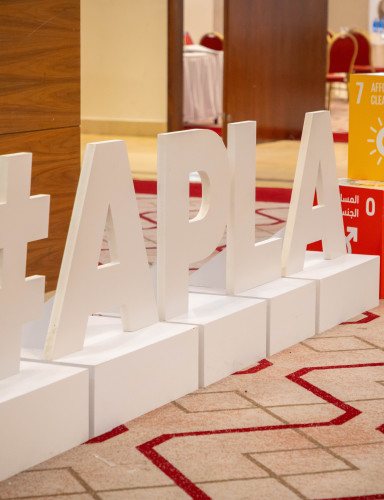


The Association of Palestinian Local Authorities (APLA), in partnership with the Barcelona City Council and the Barcelona Provincial Council, held the first introductory session under the project "Catalan-Palestinian Municipal Initiative – District 11: Cities of Palestine," in preparation for launching a specialized training program on Urban Planning and Water Management. The session brought together 52 representatives from Palestinian Local Government Units (LGUs) and 28 representatives from institutions, experts, and municipalities from Barcelona, Spain.
During the session, APLA presented the project's objectives and the framework of Palestinian-Catalan cooperation, as well as the upcoming implementation phases and the selection criteria for participating municipalities. The program will primarily target small- and medium-sized LGUs classified as Categories (B) and (C), with the aim of strengthening their technical capacities in urban planning and water resource management.
In his remarks, Mr. Abdal Mo’men Afaneh, Head of the Technical and Legal Support Unit at APLA, emphasized that:
"Urban resilience provides the technical framework that supports the broader concept of steadfastness and remaining on the land. In an environment where access to natural resources is severely restricted, the ability of municipalities to manage their own affairs becomes an essential mechanism for survival and for safeguarding fundamental human rights”.
The session also featured presentations on the Palestinian and Catalan contexts in urban adaptation, planning, and water management. Eng. Mohammad Harbouk, Head of External Relations and Municipal Engineer at Battir Municipality, presented the municipality's experience in preserving its historic water terraces and its related development plans. Meanwhile, Ms. Gemma Martín and Ms. Emma Torres from the Barcelona City Council showcased Barcelona's urban transformation experience through the Superblock model, which reorganizes traffic flows and reclaims public spaces, as well as the PEPI (Program for the Regeneration of Neglected Public Spaces) initiative and the city's climate shelters, which incorporate permeable pavements and green roofs to mitigate the effects of urban heat stress.
In her presentation, Eng. Fida Abu Zeid, Head of the Engineering Department at Beitunia Municipality, outlined the challenges facing the municipality due to Israeli control over water resources and the resulting restrictions on water access for Palestinian residents. Dr. Antonina Torrens from the University of Barcelona highlighted the importance of developing localized water management solutions, noting that major water infrastructure is often externally controlled or vulnerable to disruption. She stressed that establishing local graywater treatment systems and adopting hydroponic farming technologies represent strategic approaches to enhancing reliance on local resources.
The session concluded with an interactive discussion involving representatives of Palestinian LGUs, Catalan municipalities, and the University of Barcelona. Discussions focused on the key challenges facing Palestinian municipalities, particularly in light of limited resources and ongoing restrictions. Participants underscored the importance of strengthening sustainable technical cooperation, drawing on international experiences to implement practical, low-cost, and scalable solutions that enhance the capacity of Palestinian LGUs to address environmental and climate challenges while advancing sustainable urban development.
The "Catalan-Palestinian Municipal Initiative – District 11: Cities of Palestine" project includes several key components, notably the coordination and delivery of six technical exchange and knowledge-sharing programs between Palestinian municipalities and their counterparts in Catalonia. The project also supports the implementation of two municipal cooperation projects in Palestine aimed at improving public services, promotes decentralized cooperation through municipal partnerships and twinning initiatives, and organizes two annual solidarity weeks to strengthen the international visibility of Palestine and support advocacy efforts.
APLA will soon announce the opening of applications for the specialized training programs under the project, as well as a competitive call for proposals for a grant to support the implementation of the two municipal cooperation projects that will be managed through APLA.

