
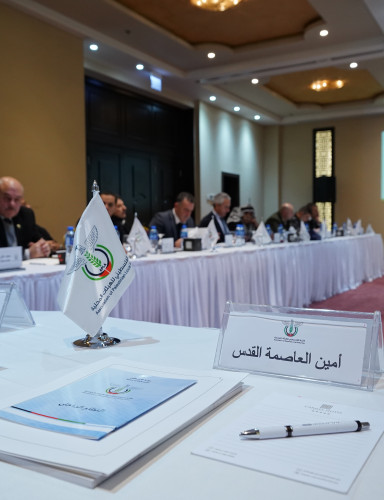

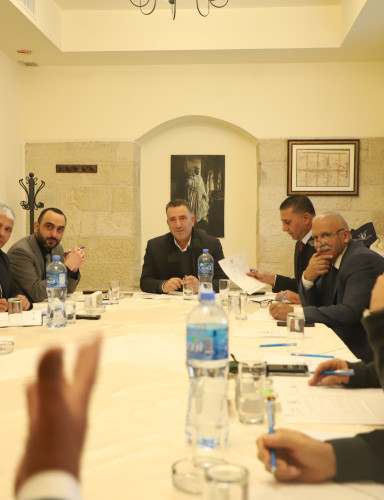



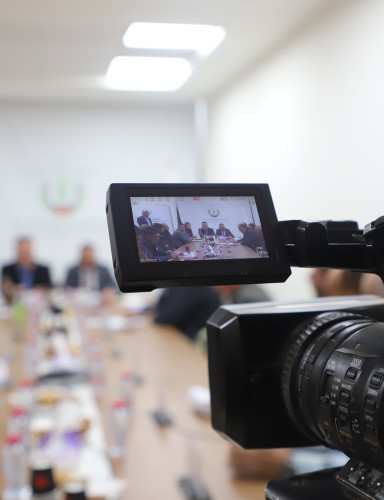

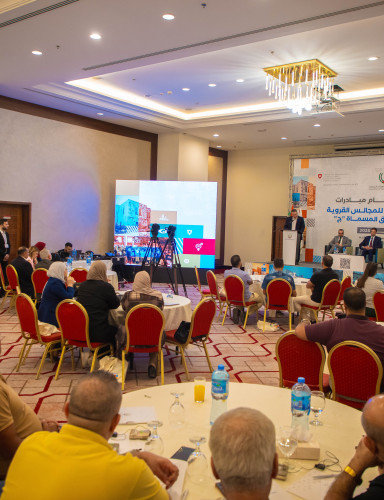


In the context of its efforts to institutionalize tools of transparency and openness in local government management, the Municipality of Salfit held a community hearing to discuss the procedures for licensing major development projects in the city. The session was held within the framework of the Promoting Accountability and Transparency of Palestinian Local Government Units (LGUs) project. This initiative is implemented by the Association of Palestinian Local Authorities (APLA) under the Transparency, Evidence, and Accountability (TEA3) program, supported by the United Nations Development Program (UNDP).
The hearing brought together representatives from the local community, developers and engineers from the private sector, Salfit Municipality’s Engineering Department staff, Dr. Ahmed Hijawi, APLA Consultant, and Deputy Mayor, Eng. Mohammed Madhi. The discussion focused on planning, regulatory, and technical aspects of project licensing, including infrastructure, environmental considerations, and alignment of designs with the Municipality’s strategic and development vision.
In his remarks, Eng. Mohammed Madhi asserted that the “Municipality of Salfit is committed to strengthening the role of citizens as an integral part of decision-making processes, particularly in relation to projects that significantly impact public facilities and community way of life. These sessions will be embraced as a recurring procedure for future investment-oriented projects.”
Dr. Ahmed Hijawi, APLA Consultant, noted that community hearings were not merely platforms for dialogue, but served as a key entry point for restoring balance in the relationship between citizens and local institutions in a context marked by trust deficits and mounting challenges in public administration. Dr. Hijawi explained that, through the Promoting Accountability and Transparency of Palestinian LGUs, APLA seeks to transform these tools from temporary initiatives into institutional practices that redefine how local policies and projects are designed. These will be grounded in shared public awareness, rather than a top-down logic or administrative centralization approach.
This session is a component of a practical model that APLA is progressively developing and activating across several LGUs. Not only does this model serve as a tool for accountability, but it is a framework for repositioning citizens at the heart of the development process. The approach aims to establish more transparent and responsive practices that rebuild trust, break the traditional top-down decision-making model, and build a genuine partnership between LGUs and respective communities in shaping priorities and directing resources.
