







Press Release Issued by the Association of Palestinian Local Authorities (APLA)
The draft Local Council Elections Law requires fundamental amendments to ensure the stability of local councils
The Palestinian government must expedite the implementation of agreed-upon commitments with local government units
An urgent rescue and recovery plan is needed for the affected governorates
In light of the recently published draft Local Council Elections Law for 2025, the Association of Palestinian Local Authorities (APLA) affirms that the draft includes positive provisions that respond to long-standing demands raised by APLA. Chief among these is enhancing public participation, expanding citizens’ authority to elect their representatives in local councils, and strengthening women's representation in decision-making positions—an approach welcomed as part of the democratic reform process.
However, APLA warns that the proposed electoral system, despite its positive aspects, may lead to instability within local councils in the post-election phase. Furthermore, APLA points out that the mechanism for electing the mayor of the local council, as currently outlined, includes procedural and administrative complexities that require comprehensive review, in-depth study, and necessary amendments.
Accordingly, APLA stresses that any legal amendments intended to ensure institutional stability and enhance the effectiveness of elected councils must be the outcome of an inclusive national dialogue with all stakeholders. In this context, APLA announces the launch of an extensive consultation process with its member committees to collect feedback, unify positions, and submit clear recommendations that ensure institutional balance and safeguard the independence of local governance.
APLA further emphasizes that any fair and modern electoral system must be based on two essential pillars: first, empowering citizens and strengthening their freedom to choose their representatives consciously and responsibly; and second, ensuring the stability of elected councils after elections, as a fundamental requirement for maintaining social cohesion and enhancing the effectiveness of local development and service delivery.
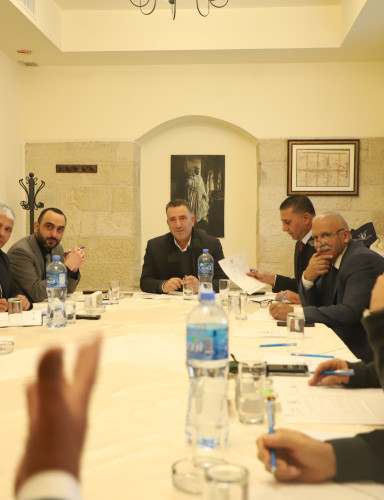
In parallel, APLA notes that the challenges facing elected councils extend beyond the legal framework and into the financial and administrative relationship with the central government. Over the past months, APLA has held a series of official meetings with the Palestinian government and its relevant institutions, particularly the Ministry of Local Government. These meetings resulted in consensus on critical issues related to expanding the powers of local government units, improving their financial resources, and enforcing existing laws. Key issues were also raised, including public accounting, financial settlements, property tax, income tax, VAT, and the transfer of accumulated dues—all within a comprehensive vision to reform the relationship between both parties and achieve financial justice.
Despite these understandings, implementation remains extremely slow and is being carried out unilaterally, without genuine engagement of local government units—undermining the effectiveness of what was agreed upon. APLA calls for a fundamental shift in how the relationship with local authorities is managed, advocating for a more flexible and participatory approach, with the allocation of real financial resources that enable municipalities to meet their obligations to citizens and continue their role in local development.
In this regard, APLA appreciates any step that contributes to organizing financial files, including the settlement of outstanding debts owed by local government unita. However, it stresses that any settlement loses its meaning if it does not also address the financial entitlements owed to local government units. Financial justice requires a comprehensive and balanced approach—without discrimination between those who owe payments and those who are owed.
In light of the unprecedented escalation across Palestinian governorates—particularly Jenin, Tulkarem, and Tubas—and the exceptional burdens that municipalities bear amid extremely limited or entirely absent resources, APLA affirms that what is needed now is not a limited intervention, but rather a comprehensive governmental move through the adoption of an urgent recovery and rescue plan. This plan must restore dignity to local communities in these areas, ensure the continuity of essential services, and strengthen the resilience of citizens and their local government units—enabling them to continue serving as a frontline provider of services and a cornerstone of Palestinian community resilience under extraordinary circumstances.