
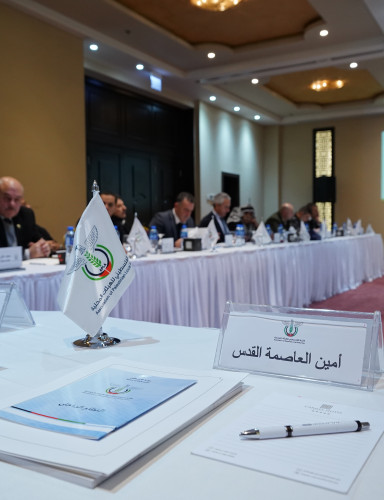

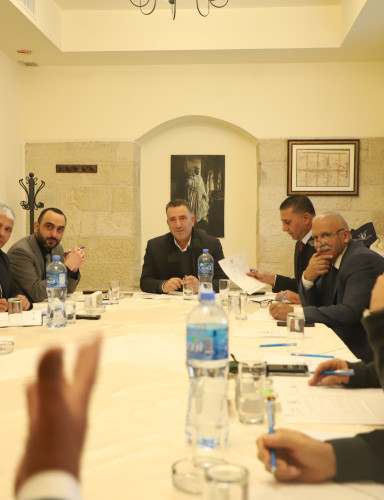



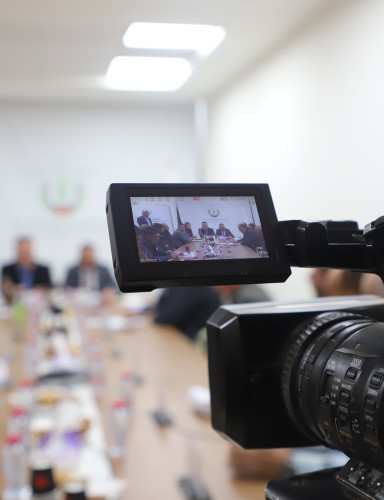


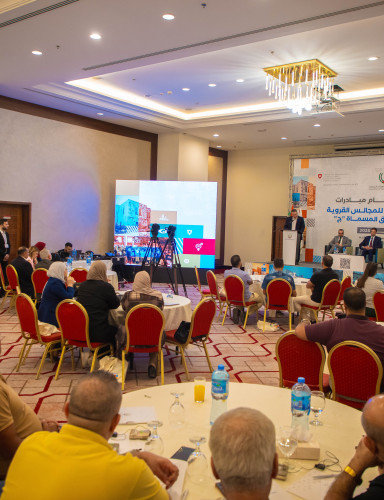


The Association of Palestinian Local Authorities (APLA) confirmed its commitment and the commitment of local authorities to the decisions of the Palestinian leadership in response to Israeli plans to annex and impose sovereignty over the Palestinian territories, stressing that the local authorities will not allow anyone to think about considering them as an alternative to the legitimate and national framework under which they belong and that they will not give up their responsibilities within the framework of Palestinian legitimacy as they did when they brought in the failure of the "Villages’ League" scheme in the past. This was during a meeting of the Executive Committee of APLA with His Excellency the Minister of Local Government Eng. Majdi Al-Saleh, with the participation of the President of APLA Eng. Musa Hadid, members of the Executive Committee of APLA, Executive Director Eng. Abdallah Anati, Deputy of the Ministry of Local Government Dr. Tawfik al-Budairi and Advisor to the Minister Walid Abu Halawa.
The Minister of Local Government Eng. Al-Saleh stressed the importance of the strategic partnership that brings together the Ministry of Local Government and APLA, saying that the Ministry of Local Government is a partner and representative of local authorities in the Palestinian government. He added, “You are the representative of the Palestinian people, and we count on you,” pointing to the seriousness of the next phase at all levels, especially the political levels that will bring local authorities more complex responsibilities.
The Executive Committee of APLA, headed by Eng. Hadid, reviewed a number of issues that concern the work of local authorities during the current period, especially after the three-month state of emergency throughout the country, stressing that local councils have not and will not, under any circumstances, fail to provide their basic and vital services affecting the lives of citizens on a daily basis. The members of the Executive Committee stressed the need to take into account the financial situation of local authorities and to speed up the transfer of debts owed to local authorities by the government, and to proceed with the implementation of the stalled projects in order to ensure the continued provision of even better basic services to citizens. The Executive Committee also called for strengthening the principle of decentralization in the work of local authorities to expand their powers and develop their services, and to strengthen national partnership with the government and its institutions so that they can respond to the requirements of the next phase.
Deputy of the Ministry of Local Government Dr. Tawfik al-Bodiri explained that the Ministry of Local Government is fully aware of all the challenges and problems faced by local authorities during the previous phase, and that the Ministry has begun to design a program to enable local authorities to go through the next phase by supporting the operational expenditure of local authorities on the one hand, and projects under the title “Labor Intensity”, adding that the Ministry looks forward to working with APLA to prepare a plan to deal with the next phase with challenges.
The President of APLA, Eng. Musa Hadid, stressed that the next stage obliges us to strengthen the internal unity of “leadership, institutions and people”, stressing the importance of preparing the grassroots to support official authorities, which begins through local authorities as the body closest to citizens. Mr. Hadid said, “The local authorities that were able to rebuild what was destroyed by the occupation within few years after the incursion of 2002 are able to be a real partner in the battle for resilience and construction.”
The Executive Committee of APLA had held a meeting prior to the meeting with the Minister of Local Government in the presence of its full members (President of APLA - Mayor of Ramallah - Eng. Musa Hadid, Deputy President of APLA - Mayor of Hebron - Tayseer Abu Snaineh, Mayor of Bethlehem - Anton Salman, Mayor of Jericho - Salem Al-Ghroof, Representative of Dura Municipality - Dr. Noman Amro, Mayor of Beit Sahour - Jihad Khair, Mayor of Al-Bireh - Azzam Ismail, Mayor of Bitunia – Ribhi Dola, Mayor of Salfeet - Abdul Karim Al-Zubaidi, Mayor of Tubas - Khaled Abdul Razeq, Mayor of Tulkarem - Mohammed Yaccoub, Mayor of Jenin, Fayez al-Saadi, Mayor of Nablus, Samih Tubileh, Mayor of Qalqilya - Dr. Hashim Al-Masri, Mayor of Barta’a- Ghassan Qabaha. The Executive Committee issued a press statement during the meeting to confirm APLA’s commitment to not engage with any Israeli entity, indicating the position of local authorities on any Israeli attempts to communicate directly with them.
The Executive Committee of APLA has formed a special committee to develop APLA’s vision of the role of local authorities in managing this crisis in accordance with four main principles to ensure that the unified address of local authorities is APLA, the need to abide by the decisions of the Palestinian leadership, maintain the level of services provided to citizens, and open a direct and permanent channel of communication with the political level to be a point of contact with the local level.
The Executive Committee decided to launch a broad international mobilization campaign with all partners and friends in the world, in order to expose the occupation plans to annex parts of the Palestinian territories and imposing coercive sovereignty over them, in flagrant contravention of all international laws and the human rights system; violated by the occupying state, systematic killings, confiscation of land, house demolitions, evacuation of residents and daily arrests.
Moreover, the Executive Director of APLA, Eng. Abdallah Anati, presented the highlights of the position paper prepared by APLA on the impact of the “Coronavirus” pandemic on local Palestinian authorities and how they dealt with this pandemic and the challenges they faced and their most important needs and requirements. Mr. Anati also referred to priority interventions to be worked on in post-Coronavirus, most importantly the need to accelerate the transfer of accumulated government debt to local authorities, allocate financial support to support local authorities and support their operational and emergency budgets as a result of the declining revenues of local authorities and the dwindling stock of supplies available to many local authorities to respond to emergency needs and provide services, as well as the need to provide local government authorities support in disaster management and response, and to launch community outreach programs and awareness campaigns for important and priority issues in the work of local government authorities, as well as the development of reliance on technological means in the provision of services and communication between citizens and local authorities.


